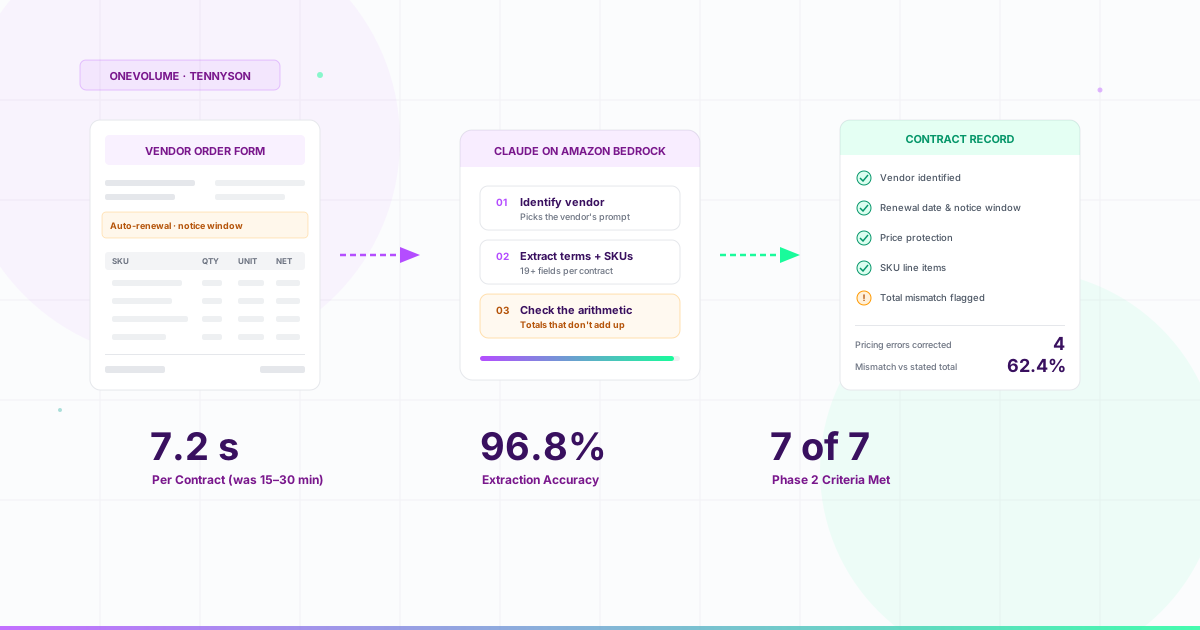
Tennyson Systems makes OneVolume, a product that shows private equity firms and procurement teams what their software contracts actually commit them to. Horus Technology built the platform on AWS, and Claude on Amazon Bedrock does the reading. A contract that used to take an analyst 15 to 30 minutes now takes 7.2 seconds.
Overview
| Challenge | Analysts copied contract terms into spreadsheets by hand. Each contract took 15 to 30 minutes, the hardest fields were right about 85% of the time, and a batch of 200 took weeks. |
| Solution | A multi-tenant platform on AWS where Claude identifies the vendor, pulls out the terms and every SKU line item, and the pipeline then checks the contract math. |
| Outcome | 7.2 seconds per contract at 96.8% accuracy across all fields, running in production in Tennyson’s own AWS account. |
About the Customer
Tennyson Systems builds software for private equity. Its product, OneVolume, pulls the commercial terms out of enterprise software contracts: when they renew, how much notice you have to give, how far the price can go up and what each line item costs. Private equity firms, their portfolio companies and procurement consultants use it to see those terms across a whole portfolio instead of one contract at a time.
Customer Challenge
Every software vendor writes its order forms its own way. Salesforce puts pricing in one place, Workday in another, and a Microsoft agreement looks like neither. Some contracts carry SKU tables that go on for pages.
Before OneVolume, someone had to open each PDF and type the details into a spreadsheet. That meant 19 fields per contract plus five more for every line item, and it took 15 to 30 minutes a contract. On the fields that matter most, such as auto-renewal terms and price protection, about 85% of entries were correct. A batch of 200 contracts took weeks.
Getting this wrong costs real money. Miss a notice window and a portfolio company can roll into another multi-year term with no cap on the price increase. These are also confidential commercial terms, so Tennyson couldn’t send them to just any AI service.
Partner Solution
Tennyson brought in Horus Technology to design and build OneVolume as a multi-tenant SaaS platform. We did the work in two phases. The first built the extraction platform and put it into production. The second taught it to handle each major vendor’s documents, pull out line-item detail and check the contract math.
How Claude reads a contract
When a contract comes in, Claude first works out which vendor wrote it. OneVolume then gives Claude an extraction prompt written for that vendor’s documents, or a general one if it hasn’t seen the vendor before. Claude sends back the order-level terms and every SKU line, with quantity, unit price, term and net price, as structured data. The pipeline runs on Claude Sonnet 4.5 through Amazon Bedrock.
Checking the math
A fast answer is no use if the numbers don’t add up, so after extraction the pipeline recalculates each contract and flags anything that doesn’t reconcile. On one reference order form worth $733,100.19, it fixed four SKU pricing errors and caught that the line items came out 62.4% away from the stated contract total.
Running on AWS
OneVolume runs in Tennyson’s own AWS account, so contracts stay in its environment, and Amazon Bedrock doesn’t use them to train models. AWS Step Functions and AWS Lambda run each step of the pipeline. Amazon DynamoDB holds the extracted data and Amazon S3 keeps the original files. Amazon Cognito handles sign-in and user roles, and Amazon CloudFront serves the React app where users upload contracts, review results and export them to Excel or CSV. The whole stack is defined in AWS CDK.
Results and Benefits
Key Results
We measured the first phase in production when we handed it over:
| Measure | By hand | With OneVolume |
|---|---|---|
| Time per contract | 15–30 minutes | 7.2 seconds |
| Accuracy | About 85% on complex fields | 96.8% across all fields |
| Cost per contract | An estimated $8–15 of analyst time | About $0.07 in AWS costs |
| Large batches | Weeks for 200 contracts | 200 contracts in one batch, 20 uploads at a time |
The second phase does more work on every contract and deals with a wider mix of vendor templates, so Tennyson set separate targets for it. It met all seven. Extraction confidence across the multi-vendor contracts reached the 90% target, and a contract now goes through the full pipeline in about 27 seconds, well inside the 45-second limit.
OneVolume is live and has completed more than 300 successful production runs. Tennyson accepted every Phase 2 deliverable and signed off on the platform as complete and running in production.
For the people using OneVolume, the biggest change is that every contract gets read. A renewal window no longer slips past because nobody had time to open the file. Every line item also lands in the database, so a team can compare what it pays for the same product across contracts. And because the totals are checked, the figures can go in front of investors without someone adding them up again first.
About the Partner
Horus Technology is a San Diego AWS Partner led by former AWS engineers. We build document processing and generative AI systems for regulated, paperwork-heavy industries. We hold the AWS Small and Medium Business Competency and are a member of the Claude Partner Network.
Highlights
| Customer | Tennyson Systems Inc. (OneVolume) |
| Industry | Financial Services / Private Equity |
| Solution | Contract data extraction and price benchmarking |
| AI model | Claude Sonnet 4.5 on Amazon Bedrock |
| AWS services | Amazon Bedrock, AWS Step Functions, AWS Lambda, Amazon DynamoDB, Amazon S3, Amazon Cognito, Amazon CloudFront, AWS CDK |
| Delivery | Horus Technology |
See also: Intelligent Document Processing | Generative AI Services | AI for Financial Services