By Michael Walker, CEO, Horus Technology
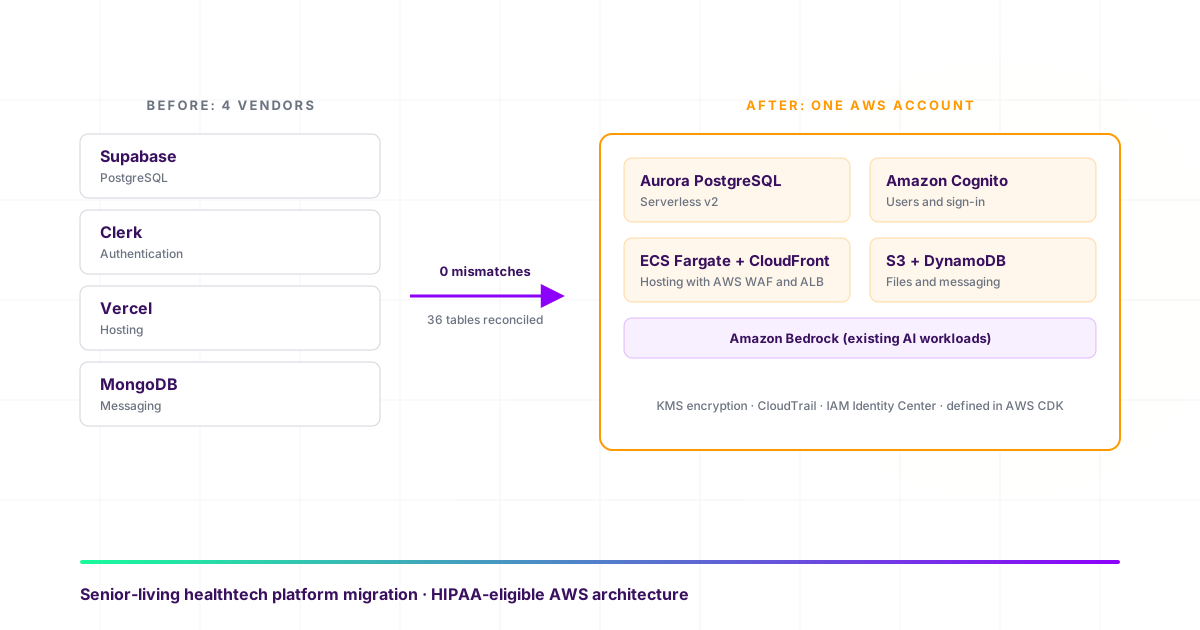
An early-stage healthtech company serving senior-living and assisted-living facilities ran its product across four separate vendors. Horus Technology moved its database, users, files, and web application into one HIPAA-eligible AWS account, with the infrastructure defined in AWS CDK, and cut over to production with every table reconciled and zero mismatches.
0
data mismatches across 36 production tables at cutover
70
users across 9 facility organizations migrated with roles intact
1
AWS account for data, sign-in, hosting, and AI
What does the customer do?
The customer builds AI tools for senior-living facilities. Caregivers record notes during their shifts, and the platform turns those notes into resident reports, health alerts, and updates for families. The platform holds resident health information, so data protection is a core product requirement. Teams in this position often start by asking whether their data is ready for AI. Its AI features already ran on Amazon Bedrock.
The challenge
Everything other than the AI ran on third-party services: PostgreSQL on Supabase, authentication on Clerk, hosting on Vercel, and messaging on MongoDB. That arrangement caused two problems:
- A harder compliance story: Larger facility groups ask about HIPAA and SOC 2 before they run a pilot. Describing controls across four vendors was much harder than pointing to one AWS account.
- A live product: Facilities were live, and caregivers use the app during shifts. No resident data could be lost, so the cutover needed a scheduled window and a rollback plan.
How did we migrate a live platform safely?
We followed one rule throughout: build a complete one-to-one copy of the platform in the customer's AWS account and leave production untouched until the customer had tested the copy and chosen the cutover window. The copy covered the database, identity, hosting, delivery pipeline, and scheduled jobs.
- Discovery: We inventoried the database (tables, row counts, and row-level security policies), the authentication setup, environment variables, scheduled jobs, and firewall rules.
- Infrastructure as code: The whole environment is defined in AWS CDK (TypeScript) as eight CloudFormation stacks covering networking, the security baseline, storage, the database, authentication, hosting, and the CloudFront WAF.
- Data layer: PostgreSQL moved from Supabase to Amazon Aurora PostgreSQL Serverless v2 in private subnets. We used scripted, repeatable dump-and-restore tooling and a reconciliation harness that compares row counts and per-table checksums between source and target. Profile photos and file attachments moved to Amazon S3.
- Identity: Users moved from Clerk to an Amazon Cognito user pool, keeping facility, organization, and role mappings. Users sign in with Google or an email code. Sign-in email is sent through Amazon SES from the customer's own domain.
- Hosting: The Next.js application moved from Vercel to containers on Amazon ECS Fargate in private subnets, autoscaling behind an Application Load Balancer. Amazon CloudFront and AWS WAF sit in front, using managed rule sets and rate limiting. This kept the firewall protection the customer had on Vercel, and the load balancer only accepts traffic that comes through CloudFront.
- Delivery pipeline: Pushes to the customer's GitLab repository trigger AWS CodePipeline, which builds a container image with AWS CodeBuild, stores it in Amazon ECR, and rolls it out to ECS. Infrastructure changes deploy from a separate repository through an OIDC deploy role, with no long-lived keys.
- Scheduled jobs: A report-drafting job that ran on Vercel cron now runs on an Amazon EventBridge schedule.
What does the HIPAA-eligible baseline include?
The customer's whole platform, including its existing Bedrock workloads, now runs in one AWS account built only on HIPAA-eligible services. The baseline covers encryption, access control, audit logging, and secrets management:
- A customer-managed AWS KMS key with automatic annual rotation encrypts Aurora and the S3 buckets that hold resident data.
- Public access is blocked on all buckets, and the database cannot be reached from the internet.
- AWS CloudTrail records activity across all regions with log file validation, and administrators sign in through AWS IAM Identity Center.
- Application secrets and database credentials are stored in AWS Secrets Manager. Database maintenance runs through an AWS Systems Manager bastion with no inbound ports open.
We also wrote a HIPAA-eligible architecture and SOC 2 readiness document. It maps the controls to the SOC 2 trust services criteria and lists the remaining gaps, which gives the customer a concrete starting point for an audit. For the wider questions around controlling who and what can reach sensitive records, see our work on information governance for AI.
How did the cutover go?
Production cutover took place on 5 October 2026 inside a scheduled 60-minute freeze window. The team rehearsed the rollback beforehand and kept the old stack intact during a seven-day hypercare period so the switch could be reversed if needed. On the day, it ran final readiness checks and then froze the application. We reconciled every table and verified sign-in, admin and caregiver access, and the live application on the production domains together with the customer.
Results
| Measure | Result |
|---|---|
| Data integrity | 36 of 36 production tables reconciled with zero mismatches (row counts and per-table checksums) |
| Users | 70 users across 9 facility organizations migrated with roles and organization membership preserved |
| Timeline | Kickoff in August 2026, production cutover on 5 October 2026 |
| Repeatability | All infrastructure defined in AWS CDK (eight CloudFormation stacks), so the customer can redeploy or extend it |
| Funding | Delivered as an AWS Partner-funded proof of concept |
The customer can now tell larger facility groups that its data, identity, hosting, and AI all run in one AWS account, on HIPAA-eligible services, with customer-managed encryption and CloudTrail audit logging.
AWS services used
Amazon Aurora PostgreSQL Serverless v2, Amazon Cognito, Amazon ECS on AWS Fargate, Elastic Load Balancing, Amazon CloudFront, AWS WAF, AWS CodePipeline, AWS CodeBuild, Amazon ECR, Amazon EventBridge, Amazon S3, AWS KMS, AWS CloudTrail, Amazon CloudWatch, AWS IAM Identity Center, AWS Secrets Manager, AWS Systems Manager, Amazon SES, Amazon SNS, AWS Lambda, AWS CDK, and Amazon Bedrock.
Planning a move to AWS?
Horus Technology helps startups and regulated businesses move off fragmented vendor stacks and onto AWS. We start with discovery, build a parallel environment in code, reconcile the data, and plan a rollback for every cutover. See our AWS migration case study, our AWS consulting services or contact us to talk through your migration.
Related reading: Another AWS migration: moving off DigitalOcean with MAP credits.