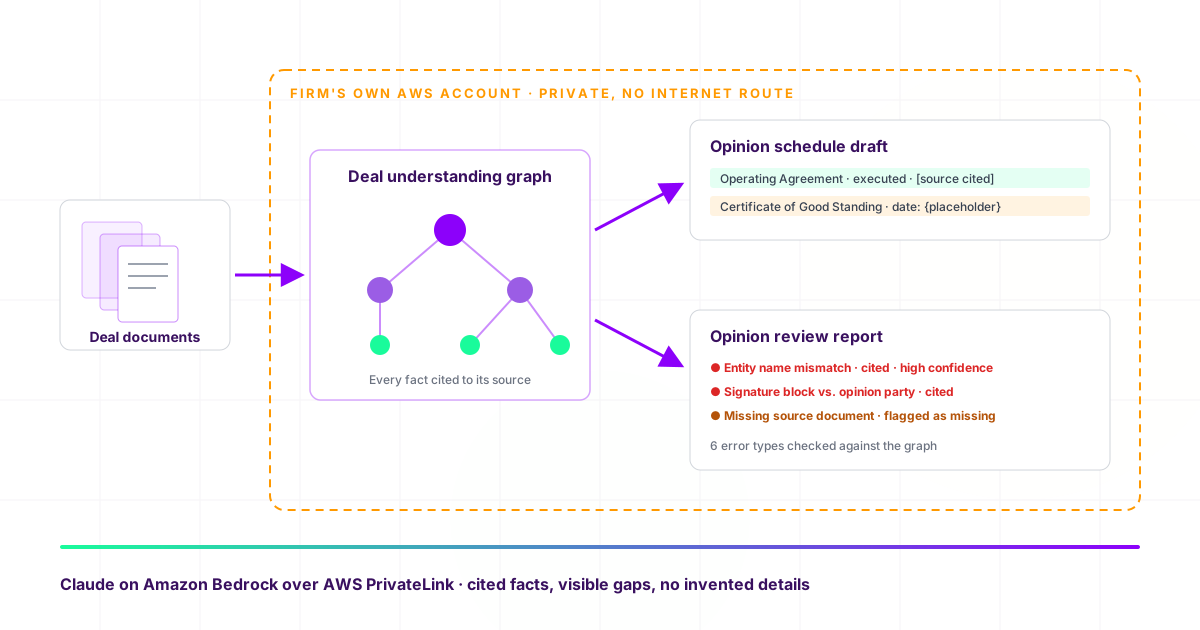
A California real-estate transaction law firm wanted AI help with legal opinion letters, but it could not risk client documents leaving its control or a model inventing a party name. Horus Technology built a proof of concept in the firm's own AWS account. Claude on Amazon Bedrock turns deal documents into a cited record of the deal, drafts the opinion schedule, and checks draft opinions for errors, and every fact it states points back to a source document.
~2 months
ahead of the planned schedule
6
types of opinion errors checked, each with a citation
0
routes from the processing core to the public internet
The customer and the problem
The firm issues enforceability, non-consolidation, and authority-to-file opinions on real-estate financing deals. Each deal arrives as a folder of loan documents, organizational documents, certificates, and successive drafts. Producing an opinion meant reading all of it by hand: extracting parties, ownership structure, dates, and defined terms, building the schedule of documents, and then checking the draft opinion against the sources. The firm puts that work at 8 to 12 hours per opinion. The common errors are hard to see by eye: an entity name that differs slightly between documents, a stale date, or a signature block that doesn't match the party named in the opinion.
The firm had three non-negotiable requirements:
- Confidentiality: Client documents could not go to a public AI service, be used for model training, or cross the public internet.
- No invented facts: An opinion letter is a legal assurance, so a tool that guesses a name or date is worse than no tool.
- Visible gaps: Opinions often go out while some facts are still outstanding, so missing information has to be shown, not filled in.
A private foundation first
Within five business days, we delivered a secure Claude endpoint in the firm's AWS account. It runs in a private-only VPC with no internet gateway and no NAT. A Lambda function behind Amazon API Gateway calls Claude on Amazon Bedrock through AWS PrivateLink interface endpoints, so no inference traffic crosses the public internet. Bedrock runs with zero data retention. Usage and cost appear in Amazon CloudWatch, and AWS CloudTrail records all activity. The environment is managed in Terraform.
How the opinion tool works
- Ingestion: A small poller syncs each matter's Dropbox folder into Amazon S3. It is the only component allowed outbound internet access, and only to Dropbox. The processing core reads from S3 and has no internet route. Documents are classified by type and checked for duplicates, and files the firm moves to its
Old Draftsfolder are marked superseded, with version history kept. - Deal understanding graph: Claude extracts parties, the ownership and special-purpose-entity structure, defined terms, dates, execution status, and signature blocks into a structured graph in Amazon Aurora PostgreSQL. This is deliberately not a retrieval (RAG) index. Each fact is stored with the document and section it came from, and the graph updates when new documents arrive while keeping a history of superseded facts.
- Never-hallucinate guard: Every generation path passes through a mandatory provenance check. No fact is stored or shown without a resolved source citation, and anything missing from the documents appears as a visible
{placeholder}. - Schedule creator: The tool drafts the opinion schedule from the graph, listing documents, parties, dates, execution status, and defined terms. It flags documents that are in the folder but were left off, and exports to the firm's own Word format after review in a web view.
- Opinion review: A draft opinion is checked against the graph for six issue types: party or entity name, jurisdiction, document date, missing source document, defined-term inconsistency, and signature block versus opinion party. Each flagged issue comes with a citation and a confidence level, and the report separates information that is missing from information that is incorrect.
- Orchestration: AWS Step Functions run the pipeline with per-stage retries and timeouts. Incomplete data becomes placeholders rather than failures. A React web app on Amazon CloudFront shows the firm what the system extracted.
Results
| Measure | Result |
|---|---|
| Delivery | All build deliverables code-complete in July 2026, about two months before opinion review was scheduled to land |
| Secure endpoint | Delivered within five business days, with Bedrock reached only over PrivateLink |
| Grounding | Every stated fact carries a source citation, and missing facts are shown as placeholders |
| Review coverage | Six categories of opinion errors checked, each flag cited with a confidence level |
| AI cost | About $0.08 of Bedrock inference for a full pass over a demo matter, from ingestion to review |
| Funding | Delivered as an AWS Partner-funded generative AI proof of concept |
Most of the monthly cost is infrastructure, such as the private endpoints and the database, not the AI itself. That matters for law firms: the model work per matter costs cents, while the private network that keeps documents off the public internet is a fixed cost the firm chose to pay.
AWS services used
Amazon Bedrock (Claude Sonnet and Claude Haiku), AWS PrivateLink, Amazon VPC, AWS Lambda, Amazon API Gateway, AWS Step Functions, Amazon Aurora PostgreSQL Serverless v2, Amazon S3, Amazon CloudFront, AWS Secrets Manager, Amazon CloudWatch, and AWS CloudTrail, provisioned with Terraform.
Bringing AI to confidential legal work
Horus Technology builds generative AI tools for firms that handle confidential documents. We keep the work in your own AWS account, ground every answer in your sources, and make gaps visible instead of guessing. Many of these projects qualify for AWS Partner funding. See our generative AI services or contact us to talk through your document workflow.