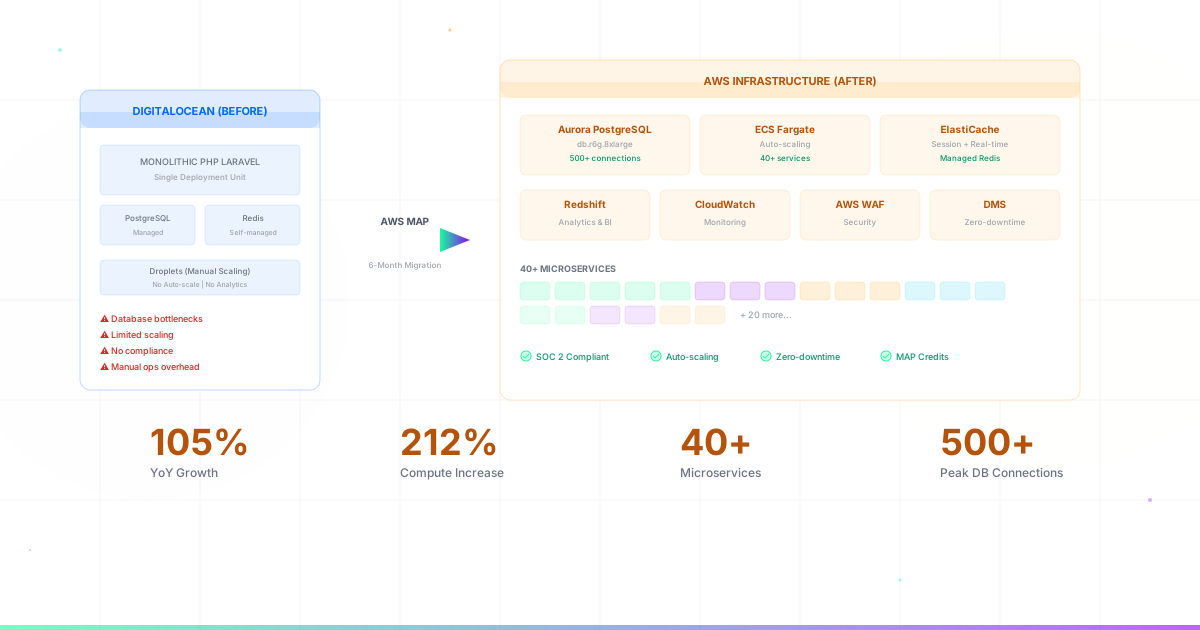
A real-time gaming platform migrated from DigitalOcean to AWS, overhauled their PHP Laravel backend, and scaled infrastructure to support 105% year-over-year growth, using AWS MAP credits to offset the migration costs.
The Challenge
Punt operates a high-traffic real-time gaming platform requiring sub-second response times, complex event processing, and strict compliance requirements. Their existing DigitalOcean infrastructure was reaching its limits:
- Database bottlenecks: PostgreSQL couldn't handle concurrent load spikes
- Limited scaling: Manual server provisioning couldn't keep pace with user growth
- Compliance gaps: Needed SOC 2 and financial services compliance
- Monolithic architecture: PHP Laravel backend was difficult to scale independently
- Operational overhead: Team spent too much time on infrastructure management
The Solution: AWS Migration with MAP Credits
Horus Technology partnered with Punt to execute a comprehensive migration using the AWS Migration Acceleration Program (MAP), which provided credits to offset migration costs while implementing a modern, scalable architecture.
Architecture Overview
| Component | Before (DigitalOcean) | After (AWS) |
|---|---|---|
| Database | Managed PostgreSQL | Aurora PostgreSQL (db.r6g.8xlarge) |
| Compute | Droplets (manual scaling) | ECS Fargate (auto-scaling) |
| Caching | Redis (self-managed) | Amazon ElastiCache |
| Analytics | None | Amazon Redshift |
| Services | Monolithic | 40+ microservices |
Migration Approach
The migration was executed in three phases over 6 months:
Phase 1: Database Migration (Weeks 1-4)
- Used AWS Database Migration Service (DMS) for zero-downtime PostgreSQL migration
- Implemented Aurora read replicas for query load distribution
- Set up automated backups and point-in-time recovery
Phase 2: Application Containerization (Weeks 5-12)
- Decomposed Laravel monolith into 40+ microservices
- Containerized all services with Docker
- Deployed to ECS Fargate with auto-scaling policies
- Implemented service mesh for inter-service communication
Phase 3: Optimization & Observability (Weeks 13-24)
- Added Amazon Redshift for business analytics
- Implemented comprehensive CloudWatch monitoring
- Set up AWS WAF for security
- Fine-tuned auto-scaling based on traffic patterns
Results: 13 Months of Growth Data
Post-migration, the platform experienced significant growth while maintaining performance and reliability:
Key Metrics
Monthly AWS Investment Growth
| Period | Monthly AWS Spend | Growth |
|---|---|---|
| January 2025 (Baseline) | $28,260 | — |
| April 2025 | $34,862 | +23% |
| July 2025 (Peak) | $157,315 | +457% |
| October 2025 | $59,190 | +109% |
| January 2026 | $57,846 | +105% YoY |
Note: The July 2025 spike reflects a major platform expansion and promotional event that required temporary infrastructure scaling.
Service-Level Growth (January 2025 vs January 2026)
| AWS Service | Jan 2025 | Jan 2026 | Growth |
|---|---|---|---|
| Amazon RDS (Aurora) | $13,094 | $22,401 | +71% |
| Amazon ECS | $4,374 | $9,341 | +114% |
| CloudWatch | $1,034 | $5,806 | +462% |
| ElastiCache | $1,915 | $3,088 | +61% |
| Redshift | $1,637 | $3,644 | +123% |
Current Infrastructure
Today, the platform runs on AWS infrastructure built to scale:
- Database: Aurora PostgreSQL cluster with db.r6g.8xlarge writer and read replica, handling 500+ concurrent connections and 4,000+ IOPS
- Compute: 40 ECS services across two accounts, with 15+ API containers auto-scaling based on demand
- Caching: ElastiCache for session management and real-time data
- Analytics: Redshift for business intelligence and reporting
- Security: AWS WAF, VPN access, CloudTrail audit logging
- Monitoring: Comprehensive CloudWatch dashboards and alerting
AWS MAP Benefits
The AWS Migration Acceleration Program provided significant value:
- Migration credits: Offset initial migration and infrastructure costs
- Partner support: Access to AWS migration specialists
- Best practices: Well-Architected Framework review
- Training: Team enablement on AWS services
Key Takeaways
Lessons Learned
- Start with the database: DMS enables zero-downtime migration for PostgreSQL
- Containerize incrementally: Break monoliths into services over time, not all at once
- Invest in observability early: CloudWatch costs scale with usage, but visibility is essential
- Plan for burst capacity: ECS auto-scaling handles traffic spikes gracefully
- Leverage MAP credits: AWS incentives significantly reduce migration risk
Ready to Migrate to AWS?
Whether you're on DigitalOcean, Heroku, or another cloud provider, Horus Technology can help you plan and execute a successful AWS migration. Our team has experience with:
- AWS MAP program qualification and credit optimization
- Database migrations (PostgreSQL, MySQL, MongoDB)
- Container orchestration with ECS and EKS
- Laravel, Node.js, and Python application modernization
See also: AWS Consulting Services | AWS Textract Guide | AWS Partner San Diego