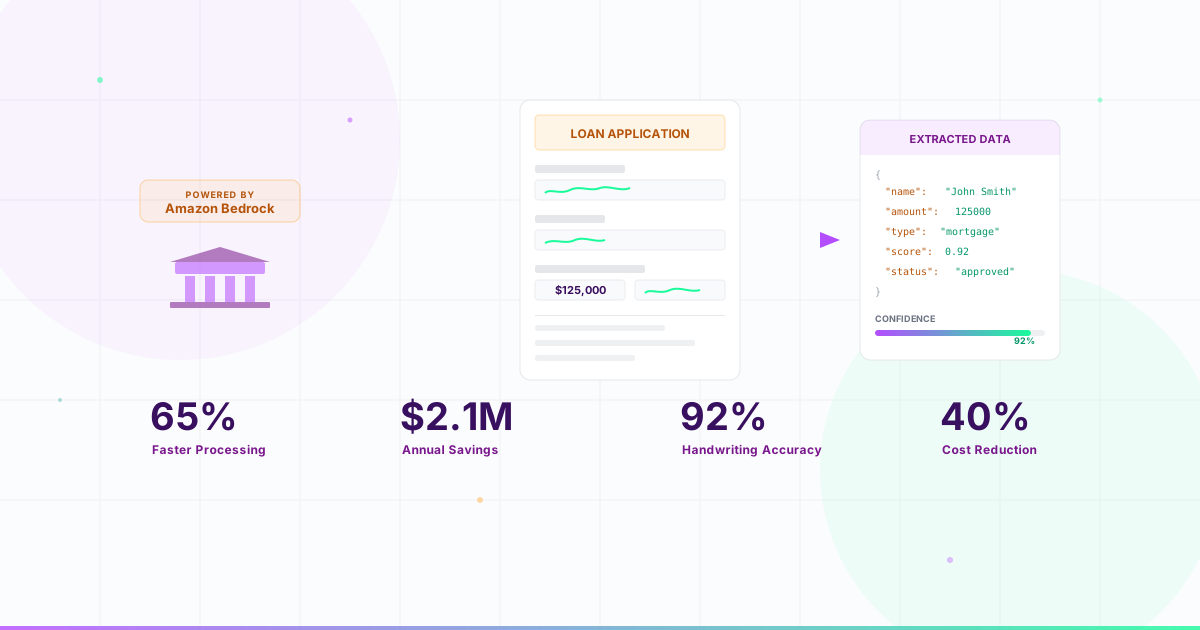
Automating handwritten loan application processing with Generative AI to deliver $2.1M in annual operational savings
The Challenge
Bank of Montreal (BMO), one of the largest banks in North America, faced a significant bottleneck in their loan processing operations. Their underwriting teams were manually reviewing loan applications that contained a mix of printed and handwritten information.
The challenges were substantial:
- Slow processing times – Each loan application took 5-7 days to process through manual review cycles.
- Handwriting complexity – Applicants filled out forms by hand, making automated text extraction extremely difficult with traditional OCR.
- Manual data entry – Staff had to manually transcribe handwritten values into digital forms, introducing errors and delays.
- Scaling limitations – During peak periods, the manual process couldn't scale to meet loan application volume.
- High operational costs – The labor-intensive process was expensive to maintain and difficult to optimize.
BMO needed a solution that could accurately read handwritten text and automatically populate their loan processing systems—without sacrificing accuracy or compliance requirements.
The Solution
Horus Technology designed and implemented an intelligent document processing pipeline powered by Amazon Bedrock's generative AI capabilities.
Architecture Overview
The solution uses AWS managed services to create a fully automated workflow:
- Amazon S3 – Secure storage for incoming loan application documents.
- Amazon Bedrock – Foundation models for advanced handwriting recognition and text extraction.
- AWS Lambda – Serverless functions to orchestrate the extraction pipeline and populate form values.
- Amazon DynamoDB – High-performance storage for extracted loan data and processing metadata.
- Amazon CloudWatch – Monitoring and alerting for system health and processing metrics.
How It Works
- Loan applications are scanned and uploaded to Amazon S3.
- An S3 event triggers a Lambda function to initiate processing.
- Amazon Bedrock analyzes each page, extracting both printed and handwritten text with contextual understanding.
- Extracted values are validated and mapped to the appropriate form fields.
- The structured data is written to the loan processing system automatically.
- Exception cases are flagged for human review through a validation queue.
The key innovation was using Bedrock's multimodal capabilities to not just recognize individual characters, but to understand the context of handwritten entries—distinguishing between names, addresses, monetary amounts, and dates based on form layout and field labels.
Results and Impact
The implementation delivered transformative results for BMO's loan processing operations:
Processing Time Reduction
5-7 days → 1.5-2 days
Annual Savings
Operational cost reduction
Handwriting Accuracy
Recognition rate
Cost Reduction
Through automation
Additional Benefits
- 99.9% uptime with 10x scalability during peak periods
- Improved customer experience – Faster loan decisions lead to higher customer satisfaction
- Reduced errors – Automated extraction eliminates manual data entry mistakes
- Audit compliance – Full traceability from source document to extracted data
Technology Deep Dive
Why Amazon Bedrock?
Traditional OCR solutions struggled with BMO's handwriting recognition requirements. Amazon Bedrock provided several advantages:
- Contextual understanding – Foundation models understand form structure and field relationships, not just individual characters.
- Multimodal processing – Can process both text and visual layout information simultaneously.
- Flexible prompting – Custom prompts allow fine-tuning extraction for specific form types.
- Enterprise security – Data stays within AWS, meeting financial services compliance requirements.
Cost Optimization
During the engagement, Horus Technology also identified an opportunity to optimize BMO's existing AI infrastructure. By migrating to Bedrock with Claude models, we projected an additional 55% reduction in their AI compute costs—on top of the operational savings from automation.
Lessons Learned
This project reinforced several best practices for enterprise AI implementations:
- Start with high-value processes – Loan processing had clear ROI metrics that justified the investment.
- Plan for exceptions – Building a human-review queue for edge cases maintained accuracy while maximizing automation.
- Measure continuously – Tracking accuracy metrics allowed us to iterate on prompts and improve results over time.
- Design for scale – Serverless architecture meant the system could handle 10x volume without architecture changes.
Is This Right for Your Organization?
If your organization processes high volumes of documents containing handwritten information—whether loan applications, insurance claims, medical forms, or government documents—generative AI can deliver similar results.
Key indicators that you might benefit from this approach:
- Manual data entry is a significant cost center
- Processing times are measured in days rather than minutes
- Traditional OCR has failed to meet accuracy requirements
- Peak volume periods create backlogs
Horus Technology specializes in building intelligent document processing solutions on AWS. Our team includes former AWS engineers who understand both the technology and the enterprise requirements that financial services organizations demand. Learn more about our AI for financial services and how automated document processing works in practice.
See also: AWS Partner San Diego | Salesforce + AI Integration