Our customer is a leading vital-records processing provider.
Their technology underpins vital statistics systems for multiple state health departments, powering services such as:
- Birth and death certificate processing
- Identity verification for public programs
- Epidemiological and public-health reporting
Every day, their platform handles large volumes of highly sensitive healthcare documents under strict HIPAA and state regulations.
To keep up with growing demand after the pandemic, they needed a new way to handle complex, multi-page medical and identity documents faster, more accurately, and at lower cost—without compromising compliance.
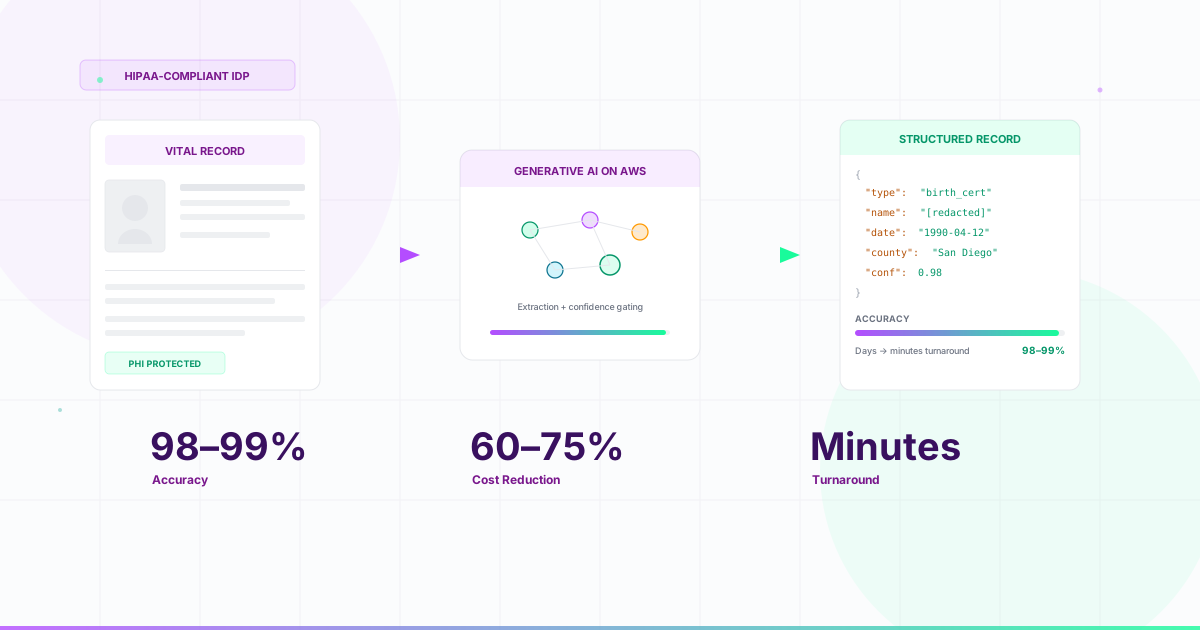
Working closely with AWS, we helped them build a Generative AI–powered document processing platform on Amazon SageMaker and a fully serverless data plane on AWS. The result: turnaround times dropped from days to minutes, accuracy now reaches 98–99%, and manual effort has been reduced by 60–75%.
The challenge: complex healthcare documents at massive scale
Our customer's quality control and identity document workflows sit at the heart of state-level vital records:
- Thousands of PDFs per day, often scanned from different systems, resolutions, and layouts
- Multiple patients and facilities mentioned in a single document
- Facility names with 10–15 different aliases across state and federal databases
- Strict 24-hour processing deadlines and HIPAA requirements
- Heavy, expensive manual adjudication whenever systems couldn't match data automatically
Existing approaches were hitting the wall:
- Traditional OCR and rules were brittle across layouts and states.
- Previous cloud-based pipelines for some workloads could take hours per batch, creating bottlenecks.
- Third-party OCR services and manual specialists were costing millions of dollars per year.
Without change, they faced:
- Unsustainable processing costs
- Growing risk of SLA breaches and regulatory penalties
- Inability to onboard new states and programs quickly
- Competitive pressure from vendors adopting AI-driven automation
They needed a platform that could understand complex healthcare documents like a human reviewer, but run at cloud scale and speed.
Why they chose Generative AI on AWS
Together with our customer, we evaluated three main options:
- Enhancing the manual process with a more modern document management system
- Classic OCR + rules and regexes for pattern matching
- Custom-trained ML models running on self-managed GPU infrastructure
Each option had tradeoffs: high labor cost, poor robustness to layout changes, long MLOps build-out, or significant operational overhead.
We ultimately chose Generative AI on AWS because it offered:
- Multimodal document understanding with a vision-language model hosted on Amazon SageMaker
- A fully managed, serverless data plane built on Amazon S3, AWS Lambda, AWS Step Functions, Amazon DynamoDB, and Amazon OpenSearch Service
- Native security, encryption, and observability aligned with HIPAA and state requirements
- Rapid time-to-value through Infrastructure as Code with AWS CDK and automated CI/CD
This approach allowed us to focus on prompts, evaluation, and business rules while AWS handled undifferentiated heavy lifting like GPU provisioning, scaling, and multi-AZ resilience.
Solution overview: from PDF to trusted data in minutes
At the heart of the solution is a Generative AI pipeline on AWS that turns incoming PDFs into structured, searchable data ready for downstream systems.
1. Secure ingest on AWS
State systems and healthcare partners submit PDFs to Amazon S3, where they are encrypted with AWS Key Management Service (AWS KMS).
An Amazon SQS queue buffers work and decouples uploads from processing. A lightweight AWS Lambda function ("start processing") reads from the queue and kicks off an AWS Step Functions state machine.
AWS at work: S3 + SQS + Lambda + Step Functions provide a fully managed, event-driven backbone that absorbs bursts without manual capacity planning.
2. Orchestrated document pipeline with AWS Step Functions
The Step Functions workflow coordinates the full lifecycle:
- PDF → JPEG conversion – pages are split into images and normalized for AI processing.
- Patient and page analysis – map states parallelize processing across pages and patient segments.
- Text Extraction – each page or patient "chunk" is sent to the Generative AI model.
- Accuracy calculation & QC scoring – extracted fields are validated, scored, and prepared for human review where needed.
Every step emits structured logs to Amazon CloudWatch, making it easy to trace a single document from upload to final result.
3. Multimodal Generative AI with Amazon SageMaker
For the AI engine, our customer selected a leading vision-language model hosted on Amazon SageMaker.
The model ingests both the image of the page and extracted text, then outputs structured JSON with patient details, facilities, requesters, and key medical fields.
Asynchronous inference uses S3 input/output locations to handle heavy workloads without blocking callers.
Model metrics like latency and error rates are monitored via CloudWatch and power autoscaling policies.
This gives them the accuracy of a multimodal LLM with the reliability of a fully managed service.
4. Durable data foundation with DynamoDB and OpenSearch
Once extraction and validation are complete:
- Amazon DynamoDB stores file metadata, processing status, and the key patient fields needed for downstream systems and reporting.
- Amazon OpenSearch Service indexes the full text and selected fields, enabling fast search and reviewer workflows.
- Final JSON outputs are written back to an encrypted S3 output bucket for audit, reprocessing, or data-lake applications.
All storage is encrypted with AWS KMS, and access is controlled via least-privilege IAM roles.
5. Access, security, and governance
Security is non-negotiable in healthcare. The platform uses a defense-in-depth AWS design:
- Amazon Cognito enforces strong authentication and optional MFA for review applications and APIs.
- All APIs are fronted by Amazon API Gateway with HTTPS/TLS only, request throttling, and detailed access logging.
- VPC-isolated Lambda and SageMaker endpoints communicate via locked-down security groups and VPC endpoints; no database or search cluster is publicly accessible.
- AWS CloudTrail and AWS Config provide full audit trails and configuration visibility.
- Infrastructure is defined with AWS CDK, enforced with cdk-nag security checks, and deployed through a multi-stage CI/CD pipeline (dev → QA → prod).
Key AWS services at the core of the solution
Although we do not publish the full architecture diagram, the platform is built entirely on AWS and relies on the following managed services:
- Amazon SageMaker – Multimodal endpoint for Generative AI document understanding
- AWS Step Functions – orchestration of the PDF→JPEG→extraction→accuracy pipeline
- AWS Lambda – event-driven processing and micro-tasks
- Amazon S3 – input, async inference artifacts, and output archives
- Amazon SQS – decoupled ingestion and back-pressure handling
- Amazon DynamoDB – file metadata and extracted field store
- Amazon OpenSearch Service – search and analytics over extracted content
- Amazon API Gateway & Amazon Cognito – secure APIs and user authentication
- AWS KMS, AWS Secrets Manager, AWS IAM, AWS CloudTrail, AWS Config – encryption, secret management, and governance
- Amazon CloudWatch – dashboards, metrics, logs, and alarms for the entire workload
AWS isn't just the hosting environment—it's the engine that powers the entire GenAI application.
Business results: days to minutes, at a fraction of the cost
The impact of the new AWS-based platform is clear and measurable.
Turnaround time: days → minutes
- Before: 1–2 business days per document, with queues and rework.
- After:
- Processing time reduced to minutes
- Median time reduced by over 95%
This allows them to comfortably meet same-day SLA commitments even under heavy load.
Accuracy and quality: towards 98–99% success
By combining multimodal Generative AI with a reviewer-in-the-loop workflow:
- Baseline first-pass accuracy was 70–80% with manual / rules-based extraction.
- The new solution consistently delivers 98–99% "business success" on key patient, facility, and requester fields.
- Reviewer corrections have been cut by roughly 50%, freeing experts to focus on edge cases and new document types.
Cost and scalability: significant savings and increased throughput
Our customer has reduced manual document processing effort by 60–75%, with a corresponding drop in third-party OCR and adjudication costs.
The serverless and SageMaker-based design scales to handle significantly higher throughput without proportional headcount increases.
Modeling shows strong ROI and a payback period measured in months at current volumes.
Behind the scenes, CloudWatch dashboards and KPI standards track:
- API 5XX and latency
- Lambda p95 duration, errors, and throttles
- Step Functions failures and execution time
- SageMaker model latency and error rates
- DynamoDB and OpenSearch health
…ensuring the platform stays within its strict SLAs.
Transforming vital-records processing with AWS Generative AI
For our customer, this project is more than a technical upgrade—it's a strategic transformation of how vital records are processed:
- Citizens receive faster decisions and responses
- State health departments gain more timely, accurate data
- Compliance posture is stronger thanks to consistent encryption, access controls, and audit trails
- The platform is ready to onboard new states and document types without a complete redesign
Generative AI on AWS turned a labor-heavy cost center into an intelligent, scalable document platform that supports the mission of public health.
About Horus Technology and AWS
Horus Technology is an AWS-focused software engineering partner specializing in cloud-native, serverless, and Generative AI solutions for regulated industries such as healthcare and government.
We design and build production workloads on AWS using services like Amazon SageMaker, Amazon Bedrock, Amazon Textract, AWS Lambda, AWS Step Functions, Amazon DynamoDB, Amazon S3, and Amazon OpenSearch Service.
By combining deep AWS expertise with strong delivery practices, we help organizations modernize legacy workflows, automate document-heavy processes, and implement secure, audit-ready platforms that are ready for real-world production at scale.