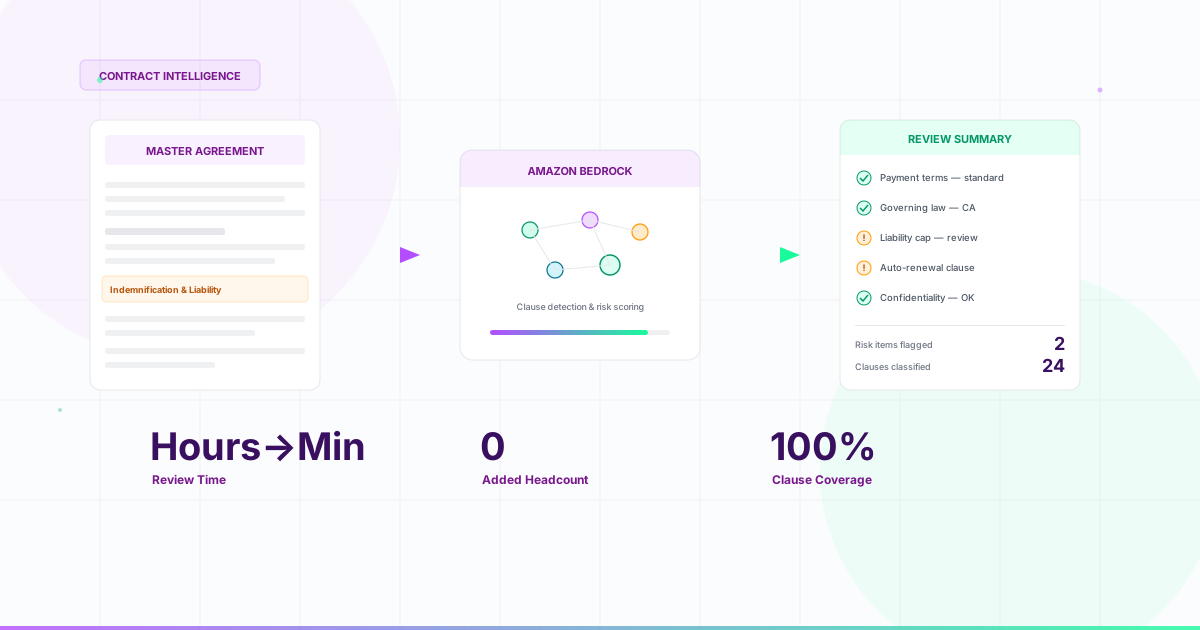
How Horus Technology built a contract-intelligence platform on AWS without increasing headcount
Business context
Horus Technology partnered with an organization that manages a large portfolio of software and service contracts. Each renewal season, their legal and procurement teams had to review piles of order forms, SKUs, discounts, terms, and renewal clauses.
The pain points were familiar:
- Slow reviews – A single complex contract could take a couple of hours to analyze end-to-end.
- High stakes – Small mistakes in quantities, discounts, or term dates could lead to overpayment or missed savings opportunities.
- Growing volume – As the business expanded, the number of contracts increased, but the review team did not.
- Limited visibility – Data ended up in scattered spreadsheets, making it hard to see portfolio-wide pricing patterns or exceptions.
The customer wanted to use generative AI to speed up contract reviews, but with strict requirements around accuracy, explainability, and security.
Project goals
Together we defined a set of business and technical objectives:
Business goals
- Cut review time from hours to minutes per contract, especially during renewal waves.
- Reach high validated accuracy on key commercial and legal fields so analysts can trust the output.
- Help teams spot inconsistent pricing and terms across vendors and contracts.
- Increase throughput by an order of magnitude without adding headcount.
- Provide auditable, source-grounded evidence for internal approvals and vendor negotiations.
Technical goals
- Run everything in a secure, multi-tenant AWS environment with clear data isolation.
- Use AWS generative AI services to extract and structure information from contract PDFs and similar documents.
- Offer a simple web UI and APIs so analysts can upload contracts, monitor processing, and download structured results.
- Implement monitoring and basic KPIs (latency, success rate, cost per contract) to continually optimize the platform.
High-level solution
Horus Technology implemented a contract-intelligence platform on AWS that:
- Accepts contract files through a browser or API.
- Stores documents securely and triggers an automated review workflow.
- Uses generative AI on AWS to extract important fields and line items from contracts.
- Validates and structures the data into a consistent schema stored in a relational database.
- Generates downloadable reports (for example, spreadsheets) that analysts can use for review, approvals, and negotiations.
- Keeps a full link back to the original text, so every extracted value can be checked against the source document.
All processing happens inside the customer's AWS account, using managed services and short-lived credentials. The platform is designed so that if a document fails automated checks, it is clearly flagged for manual review rather than silently accepted.
AWS services used in this project
To keep operations lean and security strong, Horus Technology built the solution using fully-managed AWS services:
- Amazon CloudFront & Amazon S3 – Deliver the single-page web application over HTTPS and store contract files and generated reports.
- Amazon API Gateway – Provides REST APIs for uploading documents, checking status, and downloading results.
- AWS Lambda – Implements stateless functions for API handling, contract processing steps, and export generation.
- AWS Step Functions – Orchestrates the end-to-end review workflow for each document or batch of documents.
- Amazon Bedrock – Supplies foundation models used to interpret contract content and return structured data.
- Amazon RDS for PostgreSQL – Stores normalized contract data, line items, and review metadata in a relational schema.
- Amazon Cognito – Manages user authentication and integrates with identity providers as needed.
- AWS Secrets Manager – Secures database credentials and other sensitive configuration.
- Amazon CloudWatch – Collects logs and metrics and powers alerts on errors, latency, and other health signals.
- AWS Identity and Access Management (IAM) – Enforces least-privilege access to services and data.
This stack avoids custom infrastructure and keeps the platform portable to other AWS accounts or regions.
What Horus Technology delivered
Within this project, Horus Technology delivered a production-ready platform that:
- Handles both single and bulk uploads of contracts through a web interface or automated systems.
- Processes contracts in minutes, returning structured fields and itemized pricing data for analyst review.
- Surfaces inconsistencies and exceptions (for example, unusual prices or terms) so teams know where to focus.
- Provides downloadable, review-friendly outputs that plug into the customer's existing workflows.
- Operates with transparent logging and status tracking, so operations teams can see what is happening at each step.
All of this is built using patterns that can be adapted for other domains where high-risk documents need to be read, summarized, and checked quickly.
Business impact
The customer has reported significant improvements:
- Review time per contract has dropped from hours to a small number of minutes of analyst effort.
- Teams can handle significantly more contracts per month without additional hiring.
- The platform helps identify potential overpayments and inconsistent terms earlier in the renewal cycle.
- The combination of AI plus clear source links has improved trust between procurement, legal, and finance teams.
Instead of replacing people, the system lets experts focus on judgment and negotiation, with repetitive extraction and structuring work handled by AWS-backed automation.
How this approach can be reused
The same pattern can be applied to other high-value document workflows:
- Vendor agreements and SOWs
- Insurance policies
- Healthcare or financial compliance documents
- Complex technical appendices that need standardization
If your organization is dealing with time-consuming contract or document reviews and wants to explore secure, explainable generative AI on AWS, Horus Technology can help design a solution that fits your governance and risk requirements—without exposing your business logic or competitive advantages. Explore our intelligent document processing services to see how we approach these workflows.